Largemouth Bass Lineup

Largemouth Bass Lineup

Tuesday, July 22, 2014

Older Fly Rods and Their Line Weights

Since I have started collecting vintage fiberglass fly rods, I have discovered that they used a different coding system for telling the angler what line weight the rod was designed to be fished with.  I have been asked a few times to tell people what line weight their old rod will work best with.  Since I have often used a chart such as the one below, I decided to share it here in case others might find it helpful or interesting.  So, without further ado, here is a chart showing how to convert older fly line weights:

AFTMA fly line weights - conversion to "old style" letter designations (best estimate)
AFTMA No.Avg Weight in Grains (a)Range: Mfg TolerancesDouble Taper (DT)Weight Forward (WF)Level (L)
28074-86IHIIHJH
310094-106IGIIGJG
4120114-126HFHHFGF
5140134-146HEHHEGE
6160152-168HDHHDGD
7185177-193HCHHCFC
8210202-218GBGGBFB
9240230-250GAGGAFA
10280270-290G2AGG2AF2A
11330318-342G3AGG3AF3A
12380368-392G4AGG4AF4A
13430418-442---


(a) Per 3M Worldwide / Scientific Anglers(tm), based on first 30 feet of line, exclusive of front level tip. (1 oz. = 437.5 grains)

Chart is courtesy of the Fly Fishing Forum and can be found at www.theflyfishingforum.com

Saturday, July 19, 2014

Zeb from Snowman Custom Rod Works throwing some J&M Flies Poppers

Zeb, from Snowman Custom Rod Works, sent me a message last week sharing a photo he took of one of our poppers.  If you don't remember, Zeb is a master rod builder/artist/angler/and all around great guy.  You can read more about him here from when he built me my Epic 686.  Anyways, Zeb was out throwing some J&M Flies poppers.  Amazing shot of our Oriole in action!


Monday, July 14, 2014

Comrade in Action

We got an email from a customer the other day showing our Comrade in action.  We wanted to share these photos with our followers and readers.  Glad to see that people are getting out and using them.  It does make us happy to see what others catch using our flies.


Saturday, July 12, 2014

J&M Flies in the land of the Rising Sun

Last year I started talking with Hiro, AKA Bassbum, on Instagram and Facebook.  I was surprised to learn that Japan has both bass and bluegill.  So, we decided to send some poppers his way.  In exchange, he sent us some deer hair flies.  Well the other day, Hiro was kind enough to share a photo with us.  He has been using our size 10 Fish Foolin' Frog and slaying the bluegill.  I love it!  I think it is so neat that we can say we have sent flies all over the world.


Wednesday, July 9, 2014

Update For J&M Flies

Man it is hard to believe my last post was in April.  I feel bad for that and I am sorry.  As of late, I have found it hard to blog.  I always wanted my blog to be about my fishing and tying experiences.  I never wanted this to be a blog that is just regurgitated articles and other people's posts.  If that works for someone else, great...but it isn't my style.  I haven't fished in over a year.  It is killing me!  Now that summer is upon us, I find myself even more bummed as I can't chase those smallmouth and panfish I so dearly love.  The reason for my lack of fishing....my injury.  It is hard to believe that it has almost been a year since I injured my hand.  Guess what....I'm still not even close to back to 100%.  At this point, I'd be happy to get to 75%!  I have seen eight different doctors, had five nerve blocks, three MRIs and have been on like six different types of medicine.  There is no end in sight.  In fact, this is a lifelong condition and may be a career ending injury for me.

Melissa and I never thought that my "day job" so to speak would ever interfere with my making flies.  How wrong we were!  I do not want to get into the particulars of how I was hurt or what has transpired since then but we have certainly had our ups and downs.  Melissa is working full time and doing flies every night when she comes home.  She is doing the best that she can, as fast as she can, but we refuse to sacrifice quality for quantity.  That is why the orders are taking so very long to get out.  Those that have received our flies before know how well made they are.  Yes, they take a long time to make (even longer now!) but they are worth it.  I recently received an email from a customer up in Michigan who landed 40 bluegill and half a dozen bass, including one three pounder, on a size 10 Fish Foolin' Frog...and the popper still looks like it was just made.

Please rest assured we are working as fast as we can to fill the orders.  Well, really Melissa is.  I've been demoted and am now basically her lowly assistant.  I answer email and babysit our seven year old.  We wanted to say thank you to everyone who has followed us, supported us, our fans, friends and customers.  We sincerely appreciate your patience and understanding.  We really enjoy these flies, our labor of love...I only wish Melissa was faster at it!  HA!

Friday, April 18, 2014

A Picker At Heart


No not that type of picker!  Have you ever seen the show American Pickers?  I have, and I am a big fan.  Why?  Because I like the idea of rooting around trying to find something that no one has seen for quite a while and rescuing it, preserving it for others to enjoy.  My degree is in history.  As far back as I can remember, I have always loved history.  I always wanted to be an archaeologist because... well... let's face it, I wanted to be Indiana Jones (still do, sometimes).  Later I came to realize that the idea of finding something and holding it for the first time in hundreds of years was thrilling to me.  While not hundreds of years old, I feel the same way about vintage fiberglass fly rods.  Two years ago, I made the switch to fiberglass rods and I haven't looked back.  After collecting a few contemporary rods, I decided to set my sights on some of the vintage rods.  For me, this had meaning because it's history.  I like the idea of throwing cork bodied poppers on vintage fiberglass rods for panfish and bass.  Why?  Because it just feels right.  Sometimes I think I was born during the wrong time period.  Of course, as my dear wife was quick to point out, it would not have been vintage or historic to do it back then so why bother?  History has and always will be a big part of my life and is part of the reason I decided to start collecting vintage fiberglass fly rods.

About a month ago, I was in a local fly shop speaking with the owner.  I happened to notice a fly rod on the wall.  A closer inspection revealed that the rod was fiberglass and probably around thirty or so years old.  Naturally, I had to ask if the rod was for sale but the owner said it was on loan to him from a friend.  I explained that I collected vintage fiberglass rods and that I would be interested in the rod if he ever decided to sell it.  Please don't get me wrong, I love my contemporary fiberglass rods.  My Epic and Steffen Brothers are simply outstanding rods.  However, my heart belongs to those vintage rods I seek.

A few months back, a friend of mine was browsing Craig's List when he came across a Cortland fiberglass fly rod for sale.  It was listed for $25.00.  For me Cortland is special.  They hold a special place in my heart because it was the first real fly rod I ever bought.  I bought a seven foot three weight which I used for everything.  I still have that rod and it has been broken and repaired twice.  I love it. Anyways, he offered to check it out for me and I agreed.  Later that night he dropped by the house and surprised me with the rod.  He was able to get it for $20.00.  I couldn't believe it!  Imagine, $20.00 for a 7'6 5/6 weight rod from around 1974 or so that looked like it really hadn't been used much.  I was stoked to say the least.  This was my second vintage fiberglass fly rod and my collection was off to a great start.  Collection may equal addiction depending on who you ask.  For those interested, you can read about my first one here.

Since that time, I have been scouring the internet to feed my vintage glass needs.  I have an eBay search dedicated to fiberglass fly rods and I routinely check Craig's List.  I am also always checking the for sale threads on forums such as Fiberglass Fly Rodders.  For me the hunt to find that special vintage rod and get it at a great price is thrilling in itself but fishing with them will be even more so... once I can finally fish again.  I will be sharing my collection with you in various posts so sit back, relax, and enjoy the photos as they come.  These rods really are special and fishing with a piece of history can be both exciting and rewarding.


Tuesday, April 15, 2014

Gear Review: UPG Fly Box


Several years ago, I was at a fishing lodge with a friend.  We got up early one morning to chase some trout.  I had picked out the perfect place to fish but it was on the other side of the stream.  From where we were, we could see the trout rising but we couldn't reach them.  So, we crossed the stream.  Well, attempted to cross is what I should say.  I forged ahead and quickly found myself in water up to my neck.  As my friend stood laughing, he was kind enough to take a few photos of me struggling to make it back to dry land.  For those looking for a good laugh, you can see the photo here.  Needless to say, all of my fly boxes became soaked with water.  At the time, I was using a mixture of Plano boxes along with some cheap plastic and metal fly boxes.  I'm not even sure of the exact amount of flies I lost that day but it's safe to say a few hundred.  Why did I lose them?  Up to that point, I didn't think a lot about fly boxes.  It wasn't at the top of my list of things to spend money on, as they didn't seem as sexy as a new rod or as promising as new flies.  Funny now looking back on it.  I think this is a problem common to a lot of fishermen.  Fly boxes tend to be under-appreciated and often underestimated in their value among fly fishing gear.  Upon returning home, I was determined to never let that happen again.

While searching for a sturdy, waterproof, well constructed fly box, I came across the Umpqua Professional Guide (UPG) series of fly boxes.  These boxes had won several show awards including Best Flybox of 2010 from Field and Stream magazine.  A check of the boxes revealed that they were designed to be used by professional guides.  Although not waterproof, they appeared to be well constructed and sturdy with a tight fitting lid to help to keep moisture out and they had Zerust tabs for corrosion protection.  We all have had fly boxes that have allowed our hooks to rust.  This was something else I was trying to eliminate.  These boxes also have see-through lids allowing the angler to quickly determine which box or even which side of the box he needs. Each box comes with mega-slit foam with holes allowing for easy fly placement.  With eight different styles and three colors to choose from, it seemed like a home run.  I decided to purchase the Double Wide, Day Tripper, The Midge and the Weekender.  My hope for the Double Wide was to use it for my warm water fishing needs.

Mega-slit foam and holes for easy fly placement

Zerust tab on the inside of the box

See-through lid.  Even with the plastic protective cover still on it, you can see the poppers.

Having used those boxes for the past several years I am very impressed with them.  I am not easy on gear and as such I am always looking for items to withstand my abuse and neglect.  Recently, Umpqua was kind enough to provide me with two fly boxes, the Streamer and Flats boxes, for review.  A number of reviews have already been done on the UPG series so I wasn't looking to regurgitate old information.  My goal here was to see how these boxes did with warm water fly fishing, particularly with the storage of poppers.  I wanted to see if they would be able to hold my poppers and keep them safe and sound.  As far as I know, and I could be wrong, there currently isn't a fly box on the market today geared specifically towards poppers.  My concerns were that the boxes would not have enough head room for the larger poppers or that there wasn't enough space to carry a large assortment of poppers.

Upon receiving the boxes, I placed some poppers in sizes 4, 4 pencil and 8 in the boxes in various positions, on both sides.  I then let them sit for a while.  Something I did notice was that these boxes felt heavier then other fly boxes I have used before.  Handling one, the angler can clearly get a feel of just how strong and solid they are.  In your hands, you can tell this box can take some abuse... not that that's my goal.  So, while it may be off-putting to some, the slightly heavier feel is worth it in the end to ensure protection of your flies.  A check of the poppers and boxes revealed that there was most certainly enough head room for them.  The largest size I make are size 4 TCS poppers.  These fit nicely in the foam without a problem and had head room to spare.  Over time the hackle did bend some but this was to be expected.  It probably could have been lessened to some degree had I placed the hooks a little higher in the foam.


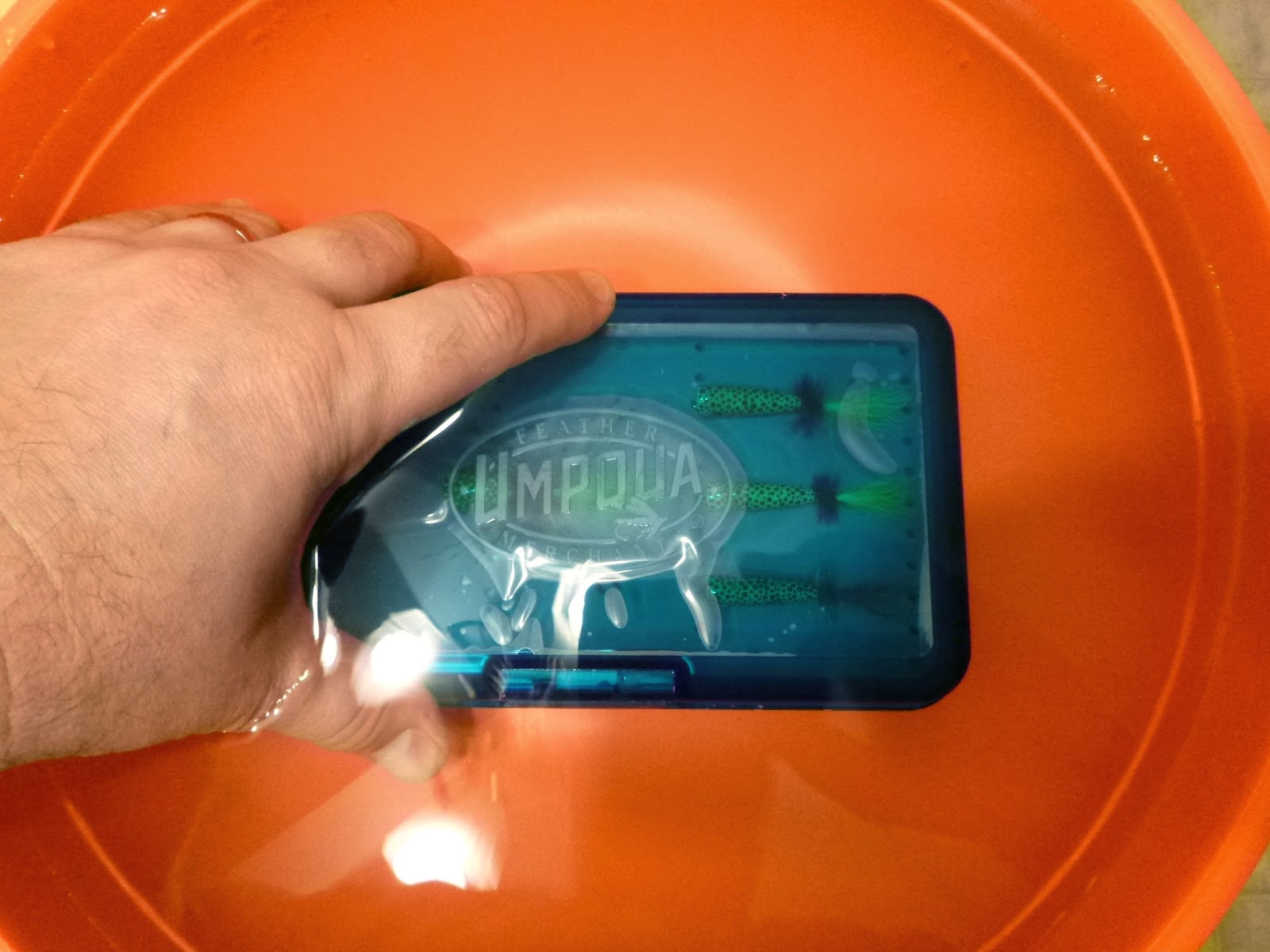
Even though these boxes are not waterproof, I still wanted to show how they do in the water. I decided to place one in the water for ten minutes.  During those ten minutes, I rotated the fly box around exposing each side of it to the water.  I then held in under water for a total of two minutes.  Despite not being waterproof, I have to say I am very impressed with the results.  Very little water actually got into the box.  There was some around the edges of the box but overall very little of it reached the foam.

The box laying in the water

The box being submerged

You can see where the water reached the foam in this photo

Water around the edges of the fly box

One thing I did notice was that if you are using a fly with legs, the last (or first depending on how you look at it) foam slit on each side of the fly box may not be able to be used.  I tried it a few times with my poppers and found that the legs of the fly actually got caught in the lid.  This could, over time, damage them.  Solution-pick a smaller fly or one without legs to be placed there.  I will say though that a large number of poppers can be stored in each box even at the bigger fly sizes.

Legs will hang outside of the box


So here is my pros and cons list:
Pros-   well constructed, sturdy, clear lid, easy fly placement, Zerust tabs, large head room, kept most of the water out despite not being waterproof
Cons-  can be pricey (ranges from 25-45 dollars), not waterproof, a little heavier than some other fly boxes

Overall I am very impressed and happy with these fly boxes. I think they will make a fine addition to anyone's warm water fly fishing arsenal.  They will last a long time.  As stated, I abuse gear and I have yet to have a problem with mine.  I would like to thank Umpqua for providing me with the fly boxes and allowing me the opportunity to do this review.